Use cases
CruiseKube is not a replacement for Horizontal Pod Autoscaler (replica scaling) or node provisioning (Karpenter, Cluster Autoscaler). It owns the vertical question: what should this pod request right now? Below are patterns that map cleanly to that model.
Platform engineering: default away from “peak YAML”
Situation: Dozens of teams copy-paste 500m / 1Gi into every Deployment because nobody wants to be paged for throttling or OOMs.
What CruiseKube does: Learns per-workload behavior, applies steady demand + shared spike headroom on each node, and exposes per-workload policy (recommend vs cruise, eviction priority) in the dashboard.
Outcome: Less spreadsheet-driven tuning, more consistent cluster utilization, fewer “mystery fat” requests.
FinOps and chargeback programs
Situation: Leadership wants visibility into waste and a credible savings estimate, not just node counts.
What CruiseKube does: Surfaces current vs recommended resources in the UI; resource pricing (configurable unit rates) turns deltas into approximate $/month views. See Resource pricing for assumptions and limitations.
Outcome: A shared artifact (the dashboard) aligns engineering and finance on “what we could save if we trusted the optimizer.”
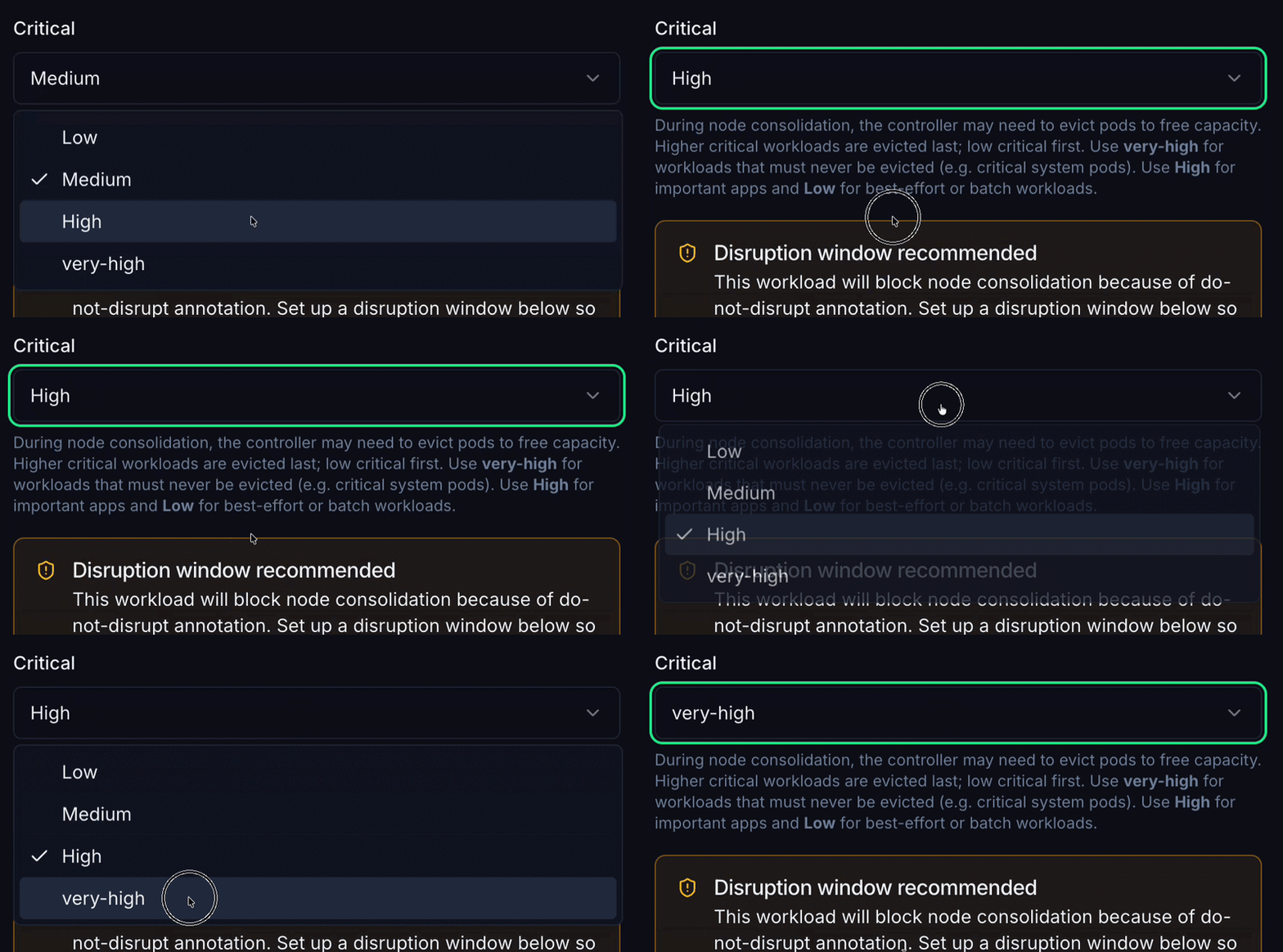
Mixed-criticality clusters
Situation: Batch jobs share nodes with latency-sensitive APIs. You need optimization without evicting the wrong tenant first.
What CruiseKube does: Eviction ranking and no-eviction classes steer who gives way when a node cannot satisfy the optimized set. DaemonSets are treated as immovable; StatefulSets and single-replica workloads get safer defaults.
Outcome: Optimization becomes a policy conversation, not roulette.
Admission safety net for bursty workloads
Situation: New pods are sized for “worst week last quarter” and immediately reserve half a node.
What CruiseKube does: The mutating webhook sets initial requests from learned peaks and history so scheduling starts from data, not folklore.
Outcome: New revisions land closer to reality before the continuous optimizer ever runs.
Complementing cluster autoscalers
Situation: Karpenter keeps you at the right node count, but pods still request more than they use—so bins look full while metrics look idle.
What CruiseKube does: Shrinks pod requests so schedulers and autoscalers see honest demand, improving packing and often delaying or avoiding unnecessary scale-out.
Outcome: Cost wins at both node and request layers.
flowchart LR
  subgraph node_layer[Node layer]
    CA[Karpenter / CA]
  end
  subgraph pod_layer[Pod layer]
    CK[CruiseKube]
  end
  CA -->|"How many nodes?"| cluster[Cluster]
  CK -->|"What does each pod request?"| cluster
Pilot-friendly rollout
Situation: You want proof on one namespace or one service line before global enforcement.
What CruiseKube does: Keep workloads on Recommend until you trust the numbers, then enable Cruise selectively per workload. See Policies & modes.
Outcome: Measurable signal (metrics + dashboard) before broad automation.
When CruiseKube is a poor fit
- CPU- or memory-based HPA is used for the same workloads (CruiseKube skips them by design).
- JVM heap tracking for dynamic container resize without process restart is needed—support is limited today; see FAQ.
- Benefit is expected without a working Prometheus and autoscaler-capable cluster topology—see Tradeoffs.
For a capability comparison to VPA, read CruiseKube vs VPA.